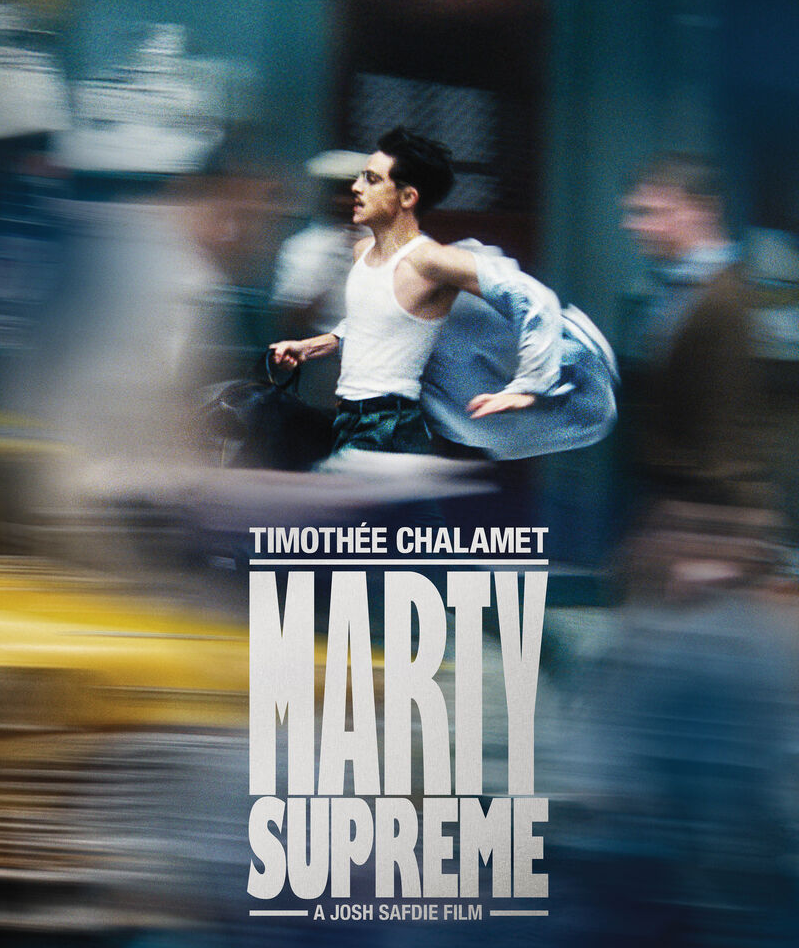
MARTY SUPREME: A NEW GUISE FOR AN ANCIENT HATRED
To foster antisemitism the medieval church arranged paintings and carvings depicting Jews being excreted by pigs. In Germany they were called “Juden Sau” or Jews sow. You can see them preserved in the choir stalls of Cologne Cathedral (1308) and in bas relief in the town church of Wittenberg (1305). Jews forced to ride or suckle from pigs was a popular theme not just in Germany but throughout Europe. Until the conclusion of Marty Supreme I could not have imagined the hateful humiliation being used to vilify a Jew in 2026.
Marty Mauser (from the German “Maus” for mouse—the way the murdered Jews of Europe are presented in Art Spiegelman’s brilliant graphic novel, “Maus”—the first of numerous borrowings by the scriptwriters) is a shallow, morally hollow narcissist who aspires to a world championship in ping-pong. The story is set in the 1950s with the Holocaust still fresh in the public consciousness. Contrast this with Budd Schulberg’s Sammy Glick character in “What Makes Sammy Run?” who made his appearance in 1941 before the mass exterminations were fully underway, but with the antisemitism of the 1930s, of Hitler and Henry Ford, on virulent display here and abroad. Like Sammy Glick, Marty Mauser seeks to escape the low class life of Brooklyn as Glick did from the Lower East Side, each with unconstrained ambition. Both characters are drawn to fit the trope of the Jew as pushy, manipulative, and unprincipled. Schulberg, himself a Jew, justified the stereotype by arguing that his goal was not to depict a Jew, qua Jew, but to expose the immorality of Hollywood and the unscrupulous means by which the powerful got there. Like Marty Mauser, Glick leaves a trail of ruined lives in his ascendant wake, but unlike Marty, who fails utterly, Glick achieves his dreams and becomes a mogul.
For unlike Glick, Marty is frankly too stupid to even consider the consequences of his actions. Or the effect of his words as when he, with gross insensitivity, off-handedly promises to do what Hitler couldn’t and finish off an opponent with a visible number on his arm. The movie amplifies the pushy and dishonest Jewish stereotype but omits the intelligence. Marty’s manipulations, his dissembling, are so transparent the viewer is continually marveling at the credulity of the supporting characters around him. Enduring two plus hours of this deeply boring, inch deep, amoral Marty is a struggle since at no point does he gain any kind of redemptive insight that would suggest characterological development. Indeed, Marty does not even prize growth and achievement in his selected sport but only the material benefits he imagines success in it will bring.
Also scrubbed from the story is anything that would reflect the true conditions for American Jews during this period: quotas at elite colleges and graduate schools; denial of corporate jobs; refusals of club memberships and even hotel rooms; implicit and explicit restrictions on home- buying with legally enforceable deed restrictions. Antisemitism was institutionalized, pervasive, and culturally accepted. Acknowledging any of this would not lessen the negative tropes used to shape Marty’s character, but it would have at least given him and us a social context in which to judge.
To compensate for giving us unlikeable uninteresting characters, the filmmakers distract us with a mess of non-actor celebrity cameos (“look that’s Kevin O’Leary—and there’s what’s his name, the basketball player, and isn’t that…”) and give us a frenetic plot—actually not so much a plot, as a series of random scenes contrived for maximum tension, but which do not advance the story line—they are simply incidental. (See “Run, Lola, Run” for freneticism with a point.) We are given Black and white guys hustling local rubes in case you missed “White Men Can’t Jump.” And then the revenge attack when they wake up (but without the thumb-breaking Fast Eddie had to endure in “The Hustler”) and the perps’ getaway after a gas station fire that comes out of nowhere.
The scenes are driven by anachronistic synth-pop music from the 1980s. Even a major subplot involving Marty’s seduction of Gweneth Paltrow’s washed up actress character has no point: neither his nor her motivation for the affair is clear. Nor the cops’ for arresting them for embracing in the park. And you will search in vain for credible motivations for most of the other characters. (Among the more ludicrous is a scene in which Marty’s uncle and former employer has paid a policeman friend to put the cuffs on Marty for taking money owed him out of the shop till—while admitting he has already recovered the amount of the missing money from Marty’s luggage. Since all’s square, the cuffs are taken off, the cop is handed cash for his services and a gratuitous line about how Jewish pastrami is superior to gentile roast beef; Marty is released from the state’s custody. But when he exits through a window, suddenly the cop and his partners give chase, for no reason other than it’s time for another chase.)
What we are presented as resolution of this misbegotten (if timely) work of antisemitism is the unearned, implied transformation of a low-life mouse into a full-grown mensch. The same Marty who exploited his friend’s wife in an adulterous relationship, and who, on learning she was pregnant, immediately denied the child was his, then proposed they give up, we see moved to tears at the mere sight of his newborn son. Maybe. But for anyone who’s read Alice Miller (or any number of other psychologists on the way narcissistic parents ruin their children) one can only be horrified at the thought of the life this kid will have.